This week Rebecca tells Laura why the book “Death in Yellowstone” is a great read but maybe not while vacationing in Yellowstone. Additionally, selfies and the dawn of phone cameras are just the modern version of decades of “Dumb Ways to Die” in the park and surrounding areas.
It’s an episode of Bears, Boilings, Bad Decisions, and Possible Murder. Listener warning, this one is more bloody than usual.
References & Further Reading:
- Lee H. Whittlesey – Death in Yellowstone (2nd edition – 2014)
- National Park Service:
- USA Today
- Tourons of Yellowstone
Transcript:
Yellowstone National Park – The Death Trap
Rebecca: [00:00:00] Hey, thank you so much for tuning in this week. Just a trigger warning. This episode deals with a lot of gore, death, and accidents that happen in natural spaces. If those are things that are unsettling to you, please skip this episode and join us another time. Similar to the Donner Party, we’re trying to be detailed, but also respectful and trying to cover as much as possible in a short amount of time.
If you have any questions, please feel free to reach out to us first before listening in. Otherwise, I hope you enjoy the show.
Another note, all of the information shared in this episode are from the late 18 hundreds until the present day. We unfortunately, do not have good records or information on how native peoples were living and working on the land, but we’d love to explore that in another episode.
Thank you so much.
[00:01:00]
Rebecca: So we are finally getting to episode three, season two of Dark Wanderings. We have both been dealing with a ton of stuff that comes with the end of the school year, life transitions with family, and just trying to continue to exist and stay sane. But we’re super stoked to be here. And some of it was me going on vacation, which didn’t help the situation.
Laura: Well, there is that. There’s also the fact that I’m just a hot mess, so I can’t, I No, please. I’m okay with being a hot mess. I have a two year old . I’m starting a side hustle. In addition to this one cuz being alive in 2023 in the, I would say we’re maybe lower middle class if we even get into the middle class.
Categorization. Yeah, it’s just as expensive to be alive.
Rebecca: Yeah. Yeah. Inflation’s no joke. Not to mention salaries don’t seem to be keeping up with [00:02:00] anything.
Laura: If my boss is listening to this, which I actually kind of hope you’re not, but if you are, I’m gonna ask for more money again at my review.
So you’re ready.
Rebecca: we should all ask for more money. That’s my opinion. Yes. Unless you’re already the CEO of something and you’re making 30 times more than your lowest paid employee which you should not be. That’s ridiculous. Please knock it off. And this is probably not the podcast for you. Yeah. I, this has nothing to do with what we’re gonna talk about today, but if you think you work 30 times harder than your lowest paid employee. You are very wrong
Stick that in your coffee and drink it.
So what are we talking about today, Laura? This has to do with the vacation I just took should I start with a vacation and we can go into what I learned?
Laura: Yeah. Let’s just dive right in. First, I, I do wanna say though that I’m glad you’re not dead.
Don’t know know if you got close, but given what we’re gonna talk about today, I am super glad that you didn’t try to like [00:03:00] hug a bison.
Rebecca: I have grown up in the woods my entire childhood, so I moved away from the woods at 19, moved to the big city of Denver. Mm. Then I’ve lived on the front range for the last 13 years.
So I have been around wildlife my entire life. So there’s just practical things that you pick up on when you’re around wildlife. So when a bear eats your pet rabbit, so. Bears are in the area quite a bit. So that’s just something that you, you know how to deal with and either use dogs to scare them away or noises.
Granted, this is mostly black bears, so they leave pretty easily.
Laura: Aw, those are the cute ones, right?
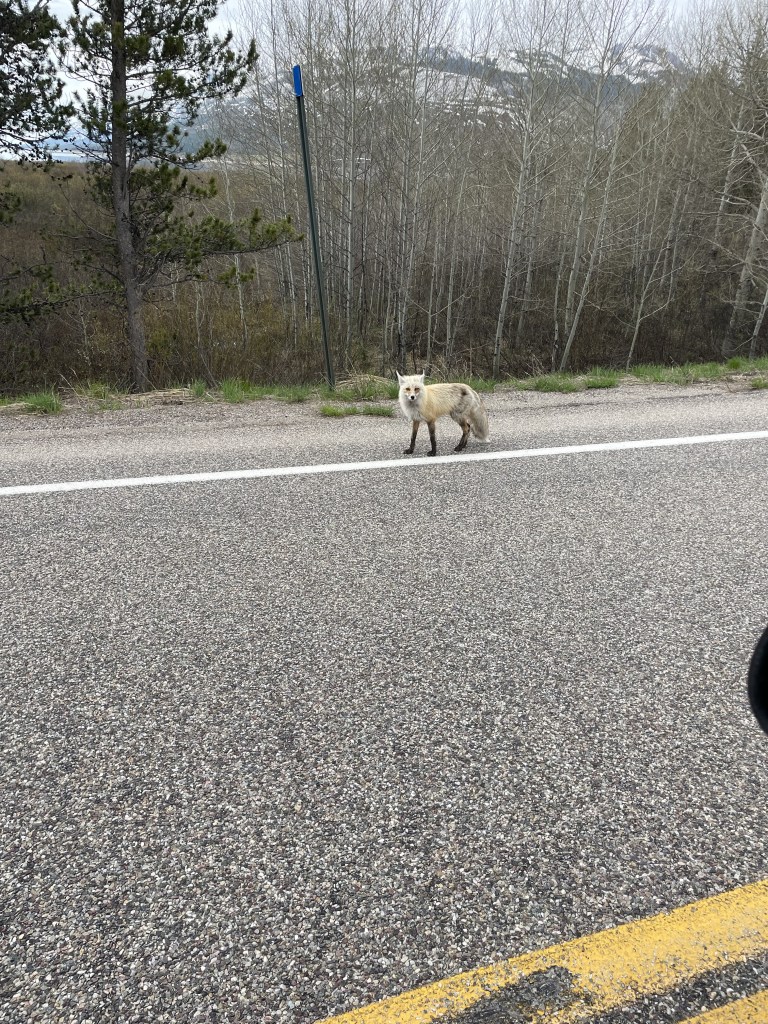
Rebecca: Yeah. Yeah. They’re pretty timid and unless you like fuck with their kids, which realistically I think anyone would be pretty nasty if you were messing with someone. So I, we grew up and we saw bear all the time, occasionally a mountain lion, a lot of bighorn sheep, deer, elk, fox, coyotes, other small predators like bobcats.
So that was just [00:04:00] around and you just knew how to kind of deal with it. They usually didn’t bother us if we had the dogs with us, and or the dogs could be used as an alarm system. That being said, I realize that that is not the common experience for most people living in these United States. So you probably don’t know how to deal with a wild bear in your backyard, or you would be so freaked out that it might ruin you wanting to live in the woods forever.
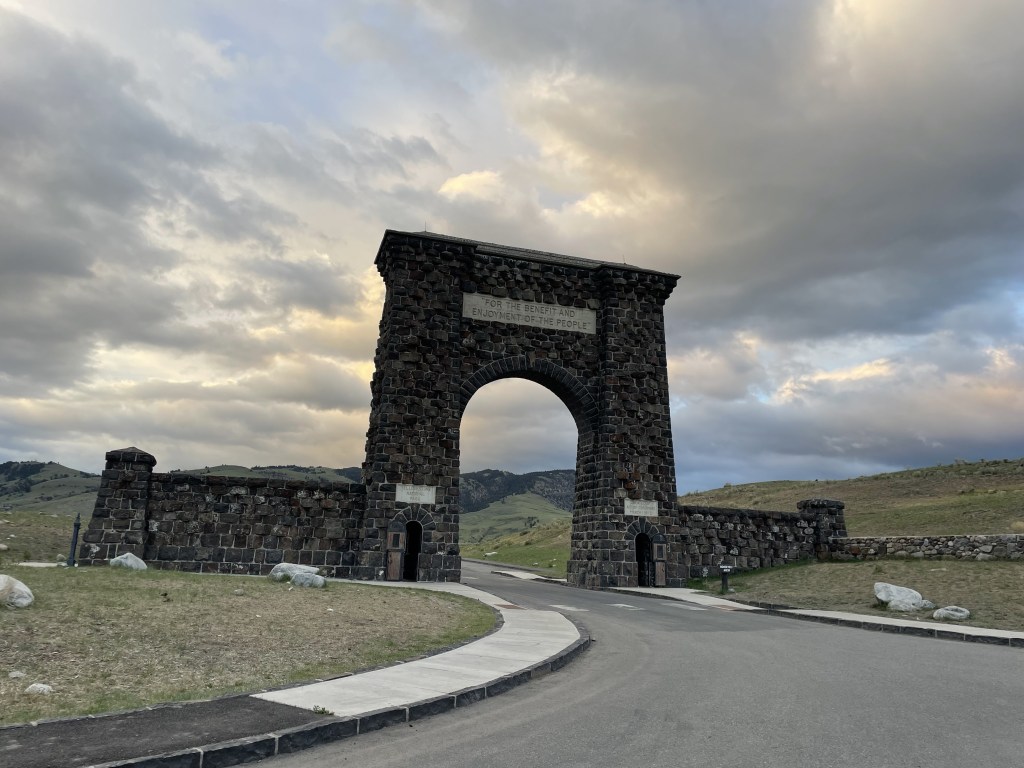
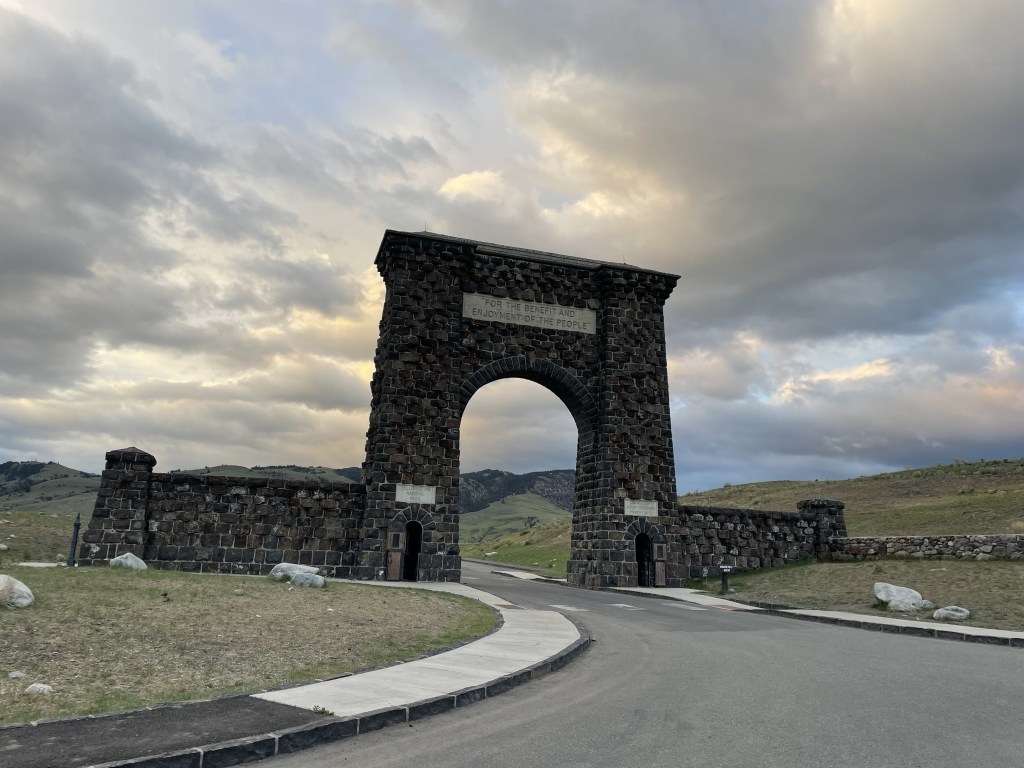
So I often go out in the woods and I feel pretty confident going out into national parks and doing things because I’m just used to wildlife, which inspired this last trip. So I did a road trip for about a week going through Teton Bridger National Forest for a couple nights, and Teton National Park, and then onto the infamous Yellowstone National Park. Which was the first officially established national park in the National Park system. Yes. In the 1870s. So it’s kind of a big deal.
A lot of people visit it every year. I had never been [00:05:00] having grown up in Colorado and even spending most of my summers as a child in Wyoming. We just never made it over to that corner of the state. So it was a sort of bucket list adventure for me. I just took my dog and I camped in my car for most of the time and it was fine. That being said, I did see a grizzly bear and three baby cubs with her. . They were yearlings. I saw a black bear that was just, eating and hanging out, not really doing much.
I saw elk, I saw deer, saw a fuck ton of bison, saw fox, a muskrat, variety of other small animals. I had to remove a ground squirrel from my accommodations in the Teton Bridger National Park or National Forest, excuse me. That was not a happy ground squirrel. And there was a lot of dog and screaming with the ground squirrel, but it was fine.
Everyone was fine. There was just, it was a lot of noise, drama. But while I was traveling around the national parks and witnessing what can only be explained as the Tourons of [00:06:00] Yellowstone which is also an Instagram page you should all follow and learn from. I saw a lot of dumb and I was like, People really don’t take this seriously.
I knew going into it that there had been a lot of incidents in Yellowstone, which we’ll get into. But I didn’t quite know how many or how bad a lot of them were until I started reading this book called Death in Yellowstone – Accidents and Full Hardiness in the First National Park by Lee H Whittlesey.
I read his second edition that came out in 2014 and man is there, there is a lot. I also do not recommend reading this while you’re actively traveling in the areas it’s talking about cuz you will not sleep well and you’ll be real freaked out because someone, you know, like died from an attack like 500 yards from where you’re sleeping.
So it’s it’s a great book. Just don’t read it while you’re actively in the national park.. So Laura, what do you know about yellowstone [00:07:00] deaths and situations.
Laura: So everybody has kind of heard of the incidents encounters with the bison in Yellowstone that’s pretty commonly known, that people are constantly underestimating.
Just how like aggressive they can get and the other thing too is bison don’t show their agitation. Like they can just be grazing and you’re like, oh, this big beautiful baby. It just wants a pet.
Rebecca: It’s just so fuzzy!
Laura: it needs a hug. And people go up and get so close and it’s like, that is not a cow for one, is not domesticated.
And. It’s not gonna tell you if it’s pissed, it’s gonna go from zero to a hundred. Immediately. And so when I was looking this up and watching videos and everything, like, cuz of [00:08:00] course people, everybody has a phone camera out now. . So there’s all kinds of video proof of people being stupid.
Rebecca: Yeah. I wish I could say that the videos were you know, you’re gonna see a video and you think it happens all the time. Like, there’s always that preconceived notion, but that doesn’t necessarily mean that happens all the time in Yellowstone.
It happens all the time. I witnessed it, like not even stopping in areas with bison, just driving through areas cuz I was onto a different destination and I’ve seen bison on and off my whole life.
But people were getting out of their cars and within 10 feet of a bison
Laura: oh God.
Rebecca: And acting as if they were just animals in a zoo and there was nothing that was going to cause any harm. And the worst part is that then they dragged their poor little children along. To see these animals and like I have minimal sympathy for an adult that should be able to read and know better.
They have signs in multiple languages. There’s a lot of bilingual, trilingual individuals at the national park, [00:09:00] and there’s a lot of information you can get including audio tours. So I feel bad for the kids. I do not feel bad for the adults making dumb decisions.
Laura: The most interesting ones that I, I watched as I was looking all of this up for the podcast is there was a situation where there was like a, a whole herd of bison had had settled across the road and people had stopped their cars. Sure. And they were like taking pictures.
Most people were staying, you know, back by their vehicles. You know, they, they were not too close or in the car. Yeah. Yeah. Which I saw a lot of, I saw a lot of people doing the right thing. Mm-hmm. I just saw a handful of people doing the dumb thing. Yeah. Which was more than enough. Yeah. But apparently there was this lady who decided that she was just gonna go get like right up there and take pictures, and you can hear people on the video going, why is she so close?
Like, what does she think she’s doing? Yeah. The bison she was taking a photograph of suddenly decided that he was camera shy and he attacked her. Mm-hmm. She got, like, he went [00:10:00] after her so aggressively and he was like throwing her around and stuff. She lost her pants. Yeah. In the attack. And like, as far as I know, like from the vid, you know, the, the report in the video.
Like she lived, like she, yeah. She ended up being okay. She spent time in the hospital, I’m pretty sure. But she was okay. But yeah, like she lost her pants and like the the bison walked away with her jeans hanging from, its, Horns.
Rebecca: Well just say the bison don’t give a fuck.
Laura: They do not
Rebecca: they can weigh over 2000 pounds, and so think of like a bull, but this is a wild animal. This has not had any type of domestication, and you’re just waving a red flag in front of it. And you have nowhere to go and you’re getting up close and personal and they’re gonna be like, what the fuck is wrong with you?
Especially if there’s babies around or they’re just trying to protect their herd and they’re gonna be annoyed clicking of shutters, the moving around flowing skirts. Apparently she had ugly and , like they’re just not gonna be keen on it. And [00:11:00] they. They’ll cut a bitch. Mm-hmm. Or gore you and toss you around like you’re a rag doll.
I, I think we’ve all seen, or a lot of us have seen the picture of the little girl some probably five years ago or a few even, just a few years ago, that basically got tossed up in the air. From a bison, she was like seven. And her family, they’re just making real dumb decisions. And luckily she was okay with like very, very minor injuries, all things considered.
But that could have ended a lot differently, and it has. One thing that the book touches on is all of the different injuries that have happened with bison. In the national Park, there’s only been two that’s compared to seven bear deaths. However, there has been countless injuries throughout the years.
So there isn’t maybe a solid number on injuries from the bison, because I’m guessing some of them aren’t reported because people realize that they’re being real fucking dumb. Additionally, there’s just not always records from every single year, which [00:12:00] is gone into in this book a little bit, but I think because this book was written in 2014, which was before like sort of the boom in social media that we’re seeing
over the last 10 years. I think that there’s probably been a direct increase in bison injuries over the last 10 years.
Laura: Like the rise of TikTok and Instagram and all of the, you know, the influencers, you know? Becoming a, you know, a huge business. I. I would say, yeah, like, and it won’t just be in Yellowstone of course, but like there’s gonna be incidences of people getting too close, right? And being like, oh, like, you know, I’m gonna go do this because it’s gonna get me followers, it’s gonna get me, you know,
Rebecca: I think that’s a big thing is like, you see a somebody doing one thing and you think, well, I wanna do that too. And it was fine when they did it, or, Wow, this is gonna be amazing picture. And even before the dawn of the social media mm-hmm. There have been people that have met [00:13:00] ill-fated ends because of their obsession with trying to get the perfect picture.
And so I think just the propensity of it is significantly higher. And I saw plenty of dumb to make that true. I don’t know if you saw it, but over Memorial Day weekend, there was a video floating around of a woman going up to a bison that was laying down and taking selfies with it.
Laura: I didn’t see that she was taking selfies.
I, I heard about it though.
Rebecca: She luckily didn’t get her, but I hope she’s in real big trouble. Then there was the guy that grabbed the baby bison that he thought that the bison had been like dismissed from the herd or something and,
Laura: but it was abandoned.
Rebecca: Right. And the national park has a very standardized nature is gonna be nature. Which they have to have or else. They’re just not going to make a real ecosystem that’s naturally how it’s supposed to be. But this guy decided he didn’t like that or that he was gonna reunite the bison and then, Of course, because he touched the bison and messed with the bison. As this happens, sometimes his herd rejected him, so they had [00:14:00] to euthanize the bison because it was the more humane thing to do.
So don’t be touching those fuzzy cows. I. Like, that’s just a, that’s a psa. That’s like the number one thing you’re gonna see in Yellowstone other than the hot water situation we’ll get into. No touchy, they’re, they’re forbidden fluff, mellows that you wanna squish.
Laura: Yeah. In general, you really shouldn’t be trying to get close to wild animals.
I don’t care if you’re, what is that guy’s name? Bear grills or something. I don’t care if you’re a super naturalist. Dude or person, don’t do it. Just leave them alone. Like that’s, that would be like somebody coming into your house to bug you. Without being invited.
That’s where they live. They’re just trying to eat. They’re just trying to poop. They don’t wanna be messed with. And you’re messing with them
Rebecca: and there is no way to communicate with a wild animal that you don’t mean harm. They have evolved over millennia to believe that you are going to harm them [00:15:00] because you are, in essence, a predator.
Like this is the number one thing that I think Americans especially forget is like we may be the top of a food chain, but that doesn’t mean we’re not part of it. We are still part of that food chain. And even at the top, Something might want to eat you or something is gonna perceive you as a threat because you are the top of that food chain.
So we’re part of that. Animals are just acting on their real instinct.
music
Laura: Where did you see a grizzly bear? Because,
Rebecca: so we’re gonna go right into the [00:16:00] grizzlies.
Laura: That’s like my, like, big fear. Big fear is, you know what, I can stay away from a bison.
I can stay away, you know, keep my distance from a black bear. But I dunno, in my brain it’s like, you know what? Grizzly bear is just gonna murder you.
Rebecca: I’ve seen grizzly bears in zoos. I’ve seen stuffed versions of them that give you an idea of what their size is, and they’re big especially compared to a black bear. Let me start with this quote from the Lewis and Clark Expedition in 1805
“of the strength and ferocity of this animal, the Indians have given us dreadful accounts”
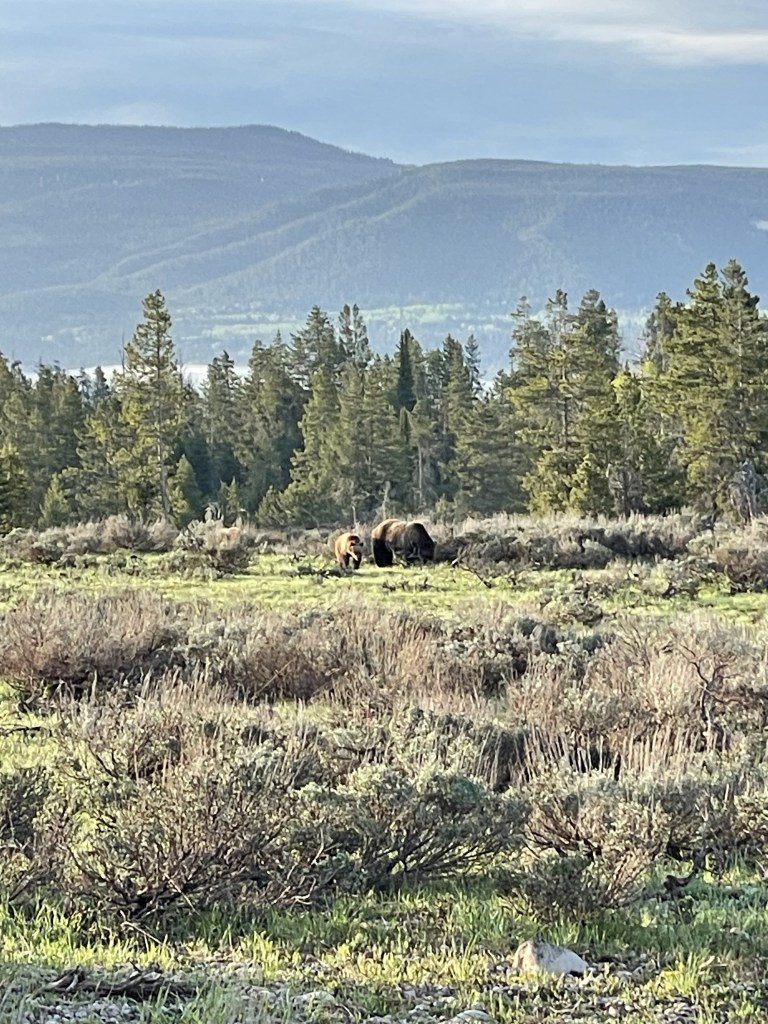
I saw Grizzly in Teton National Park. I was on my way to Yellowstone. It was early in the morning. And what’s nice about Teton is they have a group of people that are paid staff that follow around. Some of the larger predators that are closer to human areas to make sure that people can say stay safe and that the [00:17:00] animals can stay safe.
So they, they carry weapons with them. They have bear spray and they kind of set up these like parking areas so people can actually get out of their car and go see them and do it pretty safe. So this grizzly was probably 400 feet from us where we parked. You’re supposed to stay a good distance at least 300 feet away from them. So I felt pretty secure and I just stayed by my car so I could get back in if I needed to. So it’s a bear that’s been on notice around the park, and then she has three yearling cubs.
Which is pretty remarkable for any animal to have triplets and for them all to survive that long.
Laura: Yeah.
Rebecca: So they were just going through a field and munching on stuff and having their breakfast. The mom definitely had to have known we were all there. Like it’s too big of a crowd with cars and people to not know.
The Cubs were aware we were there, they were a little more apprehensive, like they’d kind of go back to mom when they’d look at us and like, it’s really just, they were just trying to make [00:18:00] sure that they were safe. And again, acting normally mom wasn’t acting aggressive. So I felt pretty safe in that moment.
It was definitely A surreal and beautiful experience to get to see an animal like that and their natural habitat. I would never wanna be any closer to a wild grizzly bear or any real grizzly bear without some type of wall or fence or something between us. Amazing creatures. But. You look at the size of their paw, and I’ll post a picture of this, like I put my hand against a cast of a grizzly bear.
Mm-hmm. Like my hand, I have almost child hands, but still to give you a perspective of just how big they are and like where those claws could really fuck you up.
Laura: Oh my gosh.
Rebecca: And I think that’s the big thing that people underestimate is like, they look so cute and fluffy, but like they can rip you in shreds in about two seconds. Because they, they’re big. Mean, kind of killing machines, like they’re really animals of opportunity. Like they’re, they’re a scavenger lot, but they will hunt and kill if [00:19:00] needed to feed themselves or to protect themselves. Mm-hmm. And that’s a big part of the Death in Yellowstone book.
So, Laura, you haven’t had any
Laura: experiences with Grizzlies? I take it. No, the, the closest I have ever been to a grizzly bear was, so there’s, oh, what is it? It’s the Bear Park in South Dakota?
Rebecca: Yeah. Yeah. Bear country USA.
Laura: Bear country it’s been many, many years. I was still like, A teenager , the last time I went through. But I remember my dad was driving of course. And like we were all in the car and I, like, I remember we drove past like the grizzly area and there’s like this huge what would it be like? It, it, it is basically a big barrier that’s not just a fence, but it’s also like, A big sloping wall that it cannot climb out of. And I, I just, that made a huge impression of me. I’m like, oh my gosh. Like that thing is super scary.
Rebecca: . And you don’t wanna be on its bad side. No, I mean, it just very much [00:20:00] reminds me of like Jurassic Park, like the T-Rex this could destroy you very quickly. Mm-hmm. And it has all of the deaths in Yellowstone from bears have been grizzlies. Black bears one, they’re not as interested in humans, but two, they’re just not as aggressive and they’re not as big. They’re a little more docile and shy, you know, not to say, don’t, please don’t go up and please don’t go up and play with a black bear.
But comparatively they’re a little easier.
A funny story I learned about why black bears are so heavily associated with Yellowstone, and again, we’re gonna talk about why they’re kind of more innocent versions is they used to have open trash pits at all of the tourist locations. Mm-hmm. Around the entire national park, which meant the bears would just go and get trash and associated humans with food. Well, then humans started feeding the bears, thinking it was like a tourist activity to just do this happened in other parts around the country.
I, I would like to think we’ve evolved [00:21:00] as a society and don’t do this as much, but they had all these open pits until the 1960s. Mm-hmm. And so it took. Years to get them closed and then to basically breed out the, the idea that humans equal food with the bears. So apparently when my dad was a kid, him and his sisters and his parents were doing a road trip through Yellowstone and my grandpa got out of the car to take a picture and had like cookie crumbs or cracker crumbs all over his pants. And this baby black bear ran up to him and started licking his pants and crawling up his legs trying to get the crumbs off of his pants. This is how these bears associated food and people, luckily he didn’t get badly injured. He had a few scratches.
Yeah. And that’s like the most common black bear injuries. And they’ve dropped significantly since they’ve stopped the trash set up. But he’s [00:22:00] also very lucky that Mama Bear wasn’t there and ready to kick his ass.
Laura: I mean, what at that point, like don’t, would you just hold still until it’s,
Rebecca: I think he’d just freeze and then hope it goes away. From my dad telling the story, the bear just kind of got bored and left, and my grandad got back in the car and carried on his life.
Laura: I would’ve been itching to pet it. But I also would’ve been like, Hmm, that’s a, that was a, that’s not smart.
Rebecca: That might be a spicy pet with a little chomp.
Laura: Spicy. Pet. Pet.
Rebecca: So I think that, like in the book, they talk a lot about black bear issues. And again, they’re mostly things like that where the babies come up. There’s other stories of. People being like, I’m gonna feed this bear. Look how friendly this bear is. And then she stopped feeding the bear. This is probably in the fifties or sixties.
And then the bear kept going after her and climbed over her wanting the food that she had and wouldn’t give her. And she got pretty beat up from it. And it was like, yeah, that’s why you don’t feed the bears dumb dumb. So it’s been an ongoing issues, [00:23:00] like people not fully comprehending the risk of animals in Yellowstone.
And it goes back well at the beginning and before it was established in National Park, but it, it’s significantly exacerbated in like sort of mid-century into the modern period of Yellowstone because people are far less connected to wildlife and sort of that common sense that comes with living in the boonies, I guess.
Mm-hmm. Or just like paying attention. And maybe I watched too many nature documentaries as a kid and read too much national Geographic, I’m not really sure, but I have a very, I consider healthy understanding and fear of these wild animals and love to see them. Love to keep a distance.
Laura: Yeah.
Well, I think part of it probably is the fact that more people are living in cities and you know, more populated areas where there are fewer animals,. That are not domesticated
Rebecca: and the animals get pushed out further and further.
Laura: They do. And then we also add to that, The prevalence of zoos [00:24:00] and where you can go in and the animals are behind, you know, the animals are safely behind a barrier fence what have you any interactions you can have with the animals are usually the safe animals, and there’s always, you know, an expert there. Someone who has a degree in something that is there to make sure that you are safe and that the animal is safe and I think that’s where people are like, oh, well this bison is so close to the walking path. Right. That they wouldn’t let it be here if it wasn’t safe. And I, I think that’s a big part of why so many people just walk right up to ’em or walk right past them and don’t realize that that’s a problem. It’s not like, no, this is where they live. This is their home. Like if you see it up there next to the path, that means you don’t go. The animals don’t have that comprehension.
Rebecca: The funnier part of that is there are people that don’t realize these animals are actually wild. Like there are countless things in the Whittlesey book at other places I’ve read online from Park [00:25:00] Rangers of why don’t you lock the animals up at night so that people can be safe? Quote, why aren’t your animals better trained to keep people safe? So there’s, there’s a very big disconnect of what wild is, and that feeds through the entirety of the Whittlesey book, but also I think where there’s all of these problems in Yellowstone in particular of death and trouble. So getting into the grizzly bear situation is basically all the bear deaths have been grizzlies, and a lot of them have been, yeah, actually people that should know what they’re doing or in the wrong place at the wrong time.
There’s instances of backpackers basically just getting pulled out of their tents or at other standard campgrounds. So I actually drove past some of the campgrounds outside of Cooke City, where they don’t allow tent camping anymore because they’ve had so much grizzly bear activity and because there were people [00:26:00] killed at those campsites.
It’s very rural far away from the majority of where people go in the park. So like it’s a little spooky to drive past that and be like, no tents. And like, I now know why. Mm-hmm. But You know, not everyone that goes there does. So it’s a little unsettling.
The other people that have been killed are like hikers. It’s been situations where usually similar to the bear, I saw it’s a mom with cubs and they suddenly feel threatened. And if you really wanna be grossed out and. Want to understand just how dangerous these animals are, I would highly recommend reading the book.
So, a prime example is there was a couple hiking. Mm-hmm. And the grizzly bear attacked the husband and ripped him up pretty bad and started devouring him.
Oh gosh. And the wife was also attacked, but she had a pack on and for some reason it just occurred to her lay down and act dead. It is speculated that that same grizzly attacked other people [00:27:00] later on.
Speaking about the photographers not always paying attention, there was a photographer that was dead set on going in the back country alone to get images of a certain grizzly bear and they don’t have enough evidence other than knowing he was basically eaten and ripped apart.
Oh geez. Just trying to get a photo and essentially like the bear, he was probably too close and the bear ran at him. Mm-hmm. And he didn’t even have time to react. So grizzly bears, again, those claws can just shred you and people have been, Mostly killed instantly with a neck attack. Mm-hmm. But there is some evidence that people were more or less eaten, partially alive.
Please take it seriously. Yeah. And please just practice safety and when in doubt ask a National Park ranger. And again, maybe don’t read this while you’re hanging out in Yellowstone, but it’s, I think it’s really important and. It’s a little bit of like the fear of God. I don’t like using that term, but this is serious. It’s not some, like we make jokes [00:28:00] about stuff and we have fun with some of these dark things, but when it comes to nature, it’s very fucking serious.
So I think like as far as most direct injuries that could occur, the animals are there, but if you’re following the rules, you’re probably fine. It’s the other, and again, a lot of this comes from not following the rules or just bad situations.
So things that Whittlesey, and he worked in yellowstone for a long time, he’s a historian and really good at documenting things and researching things. His big thing was, Do not go hiking or backpacking without at least three or four people. Mm-hmm. And I think that having read that, I will definitely reconsider some of my solo backpacking and , solo camping in certain areas. And definitely hiking solo cuz like I’ve had enough eerie experiences like in Rocky where I think there was like a mountain lion around. But I think a mountain Lion’s usually gonna fuck off if they don’t [00:29:00] think you’re actually prey. Yeah. A grizzly bear, if they’re mad enough, they don’t really give a shit.
I think it’s also an important time to mention too, like a big reason why dogs aren’t allowed in most areas of the park. And I traveled with my dog and it worked out fine. But I couldn’t do any of the trails unless I left the dog at the trailhead.
So, A big reason for that is because dogs, And animals, especially predators, can have a lot of beef with each other. Mm-hmm. And you know, it’s a dog trying to protect its human or protect itself and then an animal that’s also trying to do the same. So the big reason for a lot of those, like don’t take your dog places, is because either the dog’s gonna be viewed as prey or a threat, which can exacerbate any type of situation and run in that you might have.
And especially with the grizzly bear, that’s super important to not throw gasoline on that fire. So leave your dogs at home or leave them in the car. Keep them safe. Follow the rules of where they can and cannot be because it’s really important.
So other tips include getting bear spray making sure you know how to use it so you don’t spray [00:30:00] yourself. That happens a lot. And that’s not something you wanna get outta your clothes or your eyeballs. Oh, and traveling with groups, having things like bear bells and also knowing what to do if you are attacked, playing dead seems to be the best case knowledge. And then also staying away. If you are in an area where you accidentally come upon a bear back out slowly try to not be seen. Running’s gonna like kick in their instinct to hunt. So that’s, that’s my fun bear knowledge. Hooray. So, yeah. Out of the highlights of this book, I would say, The bear part is one of the hardest, and then we get to the geothermal problems.
Laura: Oh God.
Rebecca: What do you know about the geothermal area in Yellowstone? Because I actually didn’t know a lot going into it and I was like, oh, this explains a lot.
Laura: So it’s, it’s been a long time since I was in Yellowstone last. Okay. So I was [00:31:00] probably, 17 ish. So it it’s been like almost 20 years.
But what I do know, just from like other, you know, pieces of knowledge here and there, learning about Yellowstone as part of, you know, like learning about the history of Wyoming and the national parks since I went to the University of Wyoming. So. Probably the, the big geothermal thing is of course old faithful.
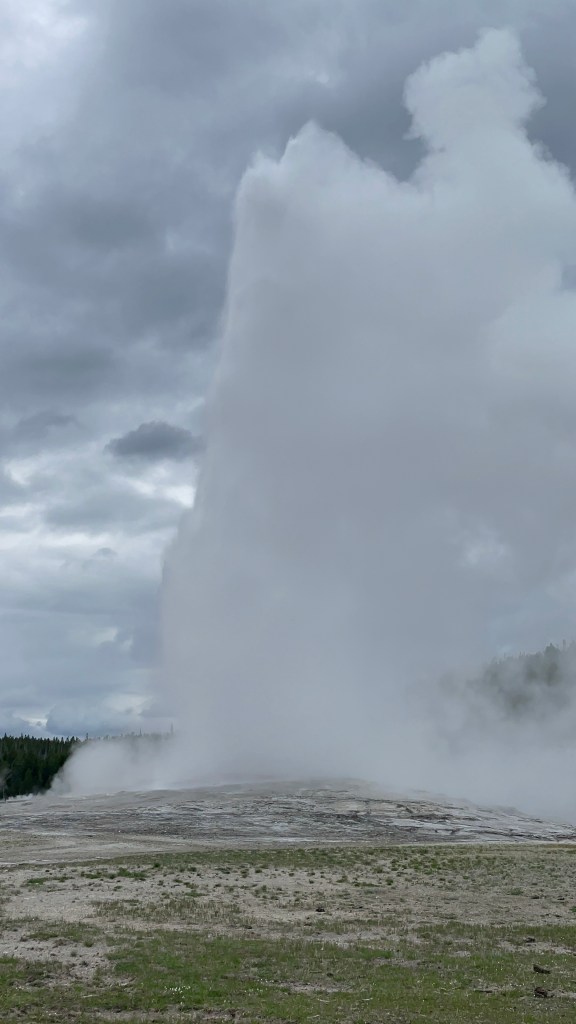
Yes. And that’s a, you know, a big draw. It’s big and there are several other geysers and everything throughout the park. There are also hot springs.
So there was this guy and his sister that were wanting to do what’s called hot potting, which is where you’re, you deviate from the trail and you’re in search of a hot spring to soak in. That is not so hot. It boiled you alive.
Rebecca: I mean, usually the better choice if you’re sticking yourself in something.
Laura: So this guy was like off walking, you know, he was not on the trail, he was not on the path, whatever. He slipped and [00:32:00] fell in. And his sister, of course, went to go get help. Because she couldn’t go in after him. She, she runs off, goes back for help. By the time she comes back with help, the guy is, they can still see the guy. His, his head is up, his shoulders, his arm, hands and upper. You know, arms are out, but he’s not responsive. He’s not moving. And there’s a storm brewing overhead it’s just bad conditions all around.
And the rescuers are like, he’s gone we can’t risk our, we can’t risk our lives to go and, and retrieve his remains. We’ll come back when it’s safe.
They get out of the storm, they come back later when it’s safe and he’s gone. And the only thing they were like, the consensus was among the rescue team that it was so hot and so acidic [00:33:00] that he literally dissolved. Yeah. Like his, there was nothing left of him.
He dissolved into that pool. It’s horrifying because I mean, what a horrifying way to die to literally be boiled and dissolved.
Rebecca: In the book, guess what the first chapter is?
Laura: That.
Rebecca: Yeah. Name of the chapter is Hold Fast to Your Children Death in Hot Water.
Laura: Oh my God.
Rebecca: There have been so many incidents of children falling into hot springs, over the decades. And that was extremely hard to read. Like you want to know the danger to preserve yourself but it is really sad and I think. It’s just really important. And I don’t wanna go into the details of the kids, but a lot of the times it was a situation where the parents weren’t watching them. The kids weren’t taking the danger seriously, [00:34:00] or people were doing things like going rogue, basically like your guy and going off on their own. So for the children’s situation, there have been many reports and many lawsuits and different things brought up. I think it’s important to understand that We have no control as people over geothermal activity.
And so what is in place is basically the safest you’re gonna get without completely destroying the environment that you’re in. It is the most active geothermal location in the world and it has mass amounts of activity concentrated in a relatively small area. And so I think it’s important that people understand that everywhere there’s some type of activity.
There have been multiple instances of people’s dogs getting loose and jumping in.
Oh geez. And of course, there’s not really anything you can do after that. But there have been people that have dived in after their pets or other animals, sometimes children, and they’ve been [00:35:00] horrifically burned and killed themselves.
There’s instances where people have swallowed hot water when they fall in or dive in. So then it like cooks everything and most of the time people end up dying from these injuries. A really long, excruciating, horrific death. I think with one of the saddest ones in the Whittlesey book was a group of park employees and I would consider experts
Happened in 1988 in February, and it was a group of snow lodge employees that went out to do some winter camping, and they were cross country skiing. They had a permitted spot that they wanted to be at, but then they got hit in a really bad snowstorm and they made camp in an , illegal spot.
Which meant that it was going to be harder for anyone to find them. . But they were stuck in the snowstorm and were like, we gotta take cover, or this is gonna get worse than it already is. And that’s some of the downside of trying to hike and work in winter is that conditions can deteriorate really badly and it gets [00:36:00] extremely cold in places like Yellowstone.
So one of the members of the party, while a group of them were cooking dinner he decided to kind of go off and look at some of the hot springs, and again, going back to the hot potting, kind of knowing where good ones were and bad ones were. So he, he wanted to go see the springs in the winter, which I could imagine are very beautiful.
. But the problem was that he somehow slipped and fell into one due to the slick winter conditions. And everyone started getting worried. They were like, where is this guy? Like, what’s happened to him? Why isn’t he coming back? So some of them started like kind of looking around and yelling for him, and then, shortly after 7:30 PM they suddenly hear all of this yelling. It’s snowing so hard that the snowflakes are slapping the side of the tent and they hear, oh God, help me, help me. All four of them scramble out of the tent and they see the man, his name was John Williams, stumbling back, holding his arms above his head and crying. My hands, [00:37:00] my hands. I hurt so bad. And then, oh God, I fell in a real hot one. It’s hurting real bad. Oh gosh. So the team. Worked extremely hard based on their expertise of trying to get the guy water and keep him hydrated. The story is really harrowing of them just trying so hard to keep this guy alive. Mm-hmm. On top of their lives are at risk because of the storm.
. So a couple of the people go out and they try to get a ranger and they try to come back and they get kind of turned around. It’s hard to find them. Luckily everyone but John Williams ends up surviving, but like their work to try to save him, like melting snow in their mouths and then spitting it in his mouth because they couldn’t melt the snow because it was so cold. Taking shifts to keep warm and trying to save everyone. Like it’s, it just shows how rough it is to be in these situations and that again, the park is no fucking joke.
In all reality. After reading this and [00:38:00] being there, I’m like, this whole damn place is a death trap. Please proceed with caution.
Laura: It’s a death trap, but take your family.
Rebecca: I mean, it’s pretty and all that, but it’s like, it’s really fucking scary some of this stuff.
Laura: So, so did he, so he, you said he fell in, did he just burn his hands or what?
Rebecca: So I’m guessing from this is he fell in and probably got burned really bad and that his hands probably trying to fight his way out or like, Just trying to catch himself were probably what was most submerged. Again, like these pools can be 180, 200 degrees Fahrenheit, which just begins to melt any type of tissue.
So again, when people escape from this, There’s a really low chance they’re gonna survive. And like you said about the kid that basically dissolved, I mean that’s, that’s the other thing is they’re full of really harsh chemicals and sulfur and different things that dissolve tissue and bodies.
And there’s other people that have randomly [00:39:00] disappeared and never been found. And there’s a question of like, how many of them fell into a hot spring somewhere? And just basically dissolved. Yeah. So it, it’s very imperative to stay on the trails and pay attention and listen to information given to you or it’s not gonna end well. And it’s sad. Like you definitely feel bad for people.
I think another one that was sad was another park employee who was young and he didn’t fit in very well . With some of his peers. And I guess a group of them went out hot potting one night and he just kind of disappeared and he didn’t come back with anyone.
And the next morning everyone’s like, well, where’s this kid? And they conveniently like, found him with. I think all of his clothes still on in a hotpot. And so it’s a question to this day, like, did he just fall in by accident and no one caught it? Or was there something more malicious that happened there?
A lot of his friends from the camp that he did get along with, or people that had come out to visit him, they’re like, well, he told us specifically not to go into the one that he died in. [00:40:00] So why would he have gone in there? Whether it was like, yeah. Drunk and alcohol and you’re not paying attention or whatever. So there’s a lot of people that have worked at Yellowstone that have also been hurt. Again, probably doing things that they shouldn’t have been doing. A lot of people push the rules in these situations. Just like in Yellowstone, it could be really fucking lethal.
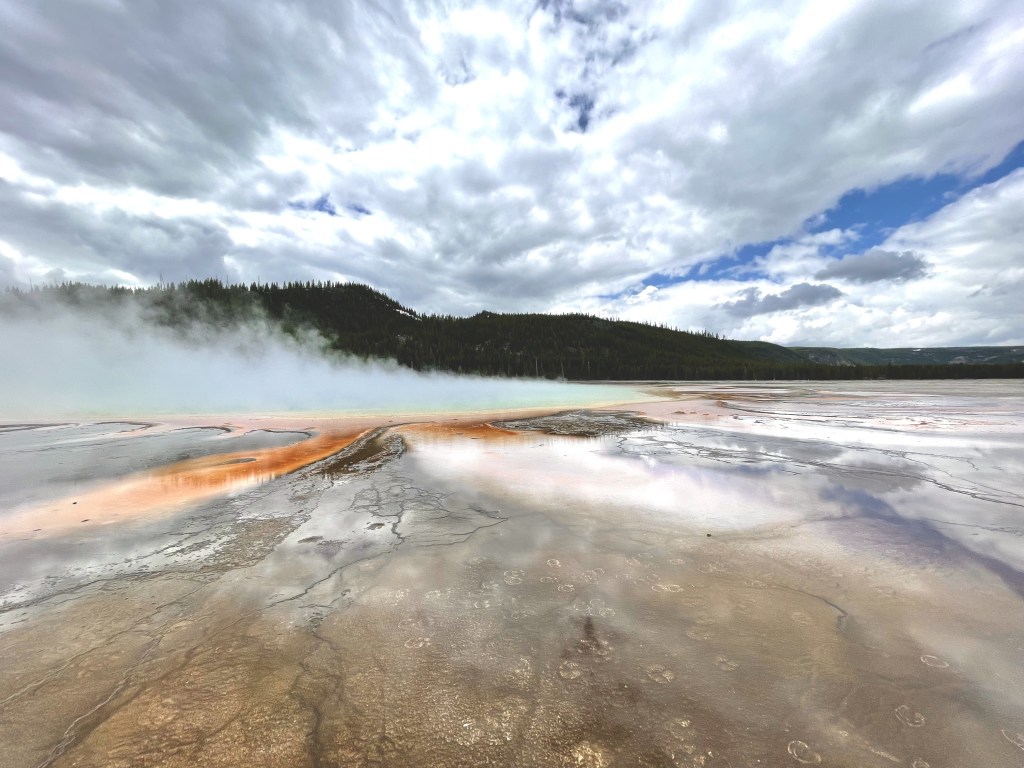
And again, these pools are beautiful. , you probably remember seeing some of the prismatic pools and like, they’re gorgeous and like, you are tempted to stick your finger in there and touch it because you know, it’s, I was, anyway, I’m like, it’s, I wonder how hot that actually is.
Like I wanna see it. This like, Terrible base, stupid human nature. And I didn’t, like, I didn’t even get close to it, but I was like, your brain’s like, lemme, I wonder what this is like, you wanna just poke it? It’s like wanting to touch a painting in the art museum. , I wonder what this feels like.
Like, no way you should do that. But your brain is being a stupid child. So don’t, don’t listen to the stupid child brain. Yeah, that, that’s my PSA on that. [00:41:00] that.
Music
Rebecca: There’s a lot of other stories of things like freezing to death. Some of those stories were, national Park employees. And Forest Service Rangers that were literal heroes trying to keep other people alive in bad snowmobiling incidents or freak snow storms or whatever else. So there’s a lot of heroes in this book and Whittlesey knew a lot of them that have died in the more recent decades.
There’s a lot of, there’s random murders and suicides you know, like you would expect for just about any popular destination in the world. Some of them are really silly, you know, land disputes or this and that.
Music
Rebecca: We live next to Rocky Mountain National Park, and I’ve been up there a lot over the years. Mm-hmm. I’ve. I’ve lived in northern [00:42:00] Colorado. And like I just see stupid all the fucking time, like especially around elk and elk rutting season, which is mating season.
So the males are far more aggressive than people expect. Mm-hmm. And I see people like dragging their kids up to these males with giant racks. And thinking like, cool, that could like go in your fucking eyeball. Or your stomach or some other squishy bit and like leave you either permanently injured or killed, which does happen.
And you see people around Estes Park getting way too close all the time. And you know, that’s just one species. I was backpacking in Rocky Mountain National Park and the only animal I’ve had a really almost violent run in with was a moose and I was with two friends and the moose we came upon, one of them had a newborn and she was fine. But then there was another one which had I think a yearling with her and she was fucking mad that we existed. We were in the designated camp spot. We [00:43:00] were in a designated trail.
Backpacking didn’t even have a fire. And she just was mad that we were close to what she deemed her territory. Yeah. And her area to graze. And she started charging at the camp. And luckily we had a whistle and banged some pots and that sort of thing. And she left us alone. But there was a hot second there I was like, this, this mama is gonna run through my tent. . And she might kill me cuz like, like elk. They also rear up on their back legs and smack people with their front. They do like this kicking. Karate move.
Laura: Moose karate.
Rebecca: You know, you don’t really want one of those hoofs in your face. And moose are fucking big. People don’t realize, especially bull moose, how big they can get. in my experience, female moose have always been more aggressive.
I’m sure there’s plenty of stories. I’ve seen plenty of videos, much like the bear and bison videos and nature is not really forgiving.
So. That’s kind of Yellowstone in a nutshell. From the Whittelsey [00:44:00] Book and my understanding of other areas, it is essentially the most lethal and dangerous part of the National Park system, and I now have a better understanding of why. And it’s, you know, mass amounts of people, millions of people every year combined with some of the most lethal and dangerous animals in one of the most rural and wild parts of the country.
Laura, I suggested you look up some other national parks and death what did you learn?
Laura: So, I did look up other national parks. Yeah. But my brain dumped all of that information while I was driving over here. However, one thing I do think we should talk about, cuz this, this applies to all national parks. Just because it’s so prevalent now with people with selfies and photos for Instagram and cool TikTok there are a lot of people that fall and get injured or even killed. Because they were trying to get the perfect shot. Or
Rebecca: hit by a [00:45:00] car.
Laura: So one of the things that I was reading up on is at Yosemite. Have you been to Yosemite?
Rebecca: No, I haven’t.
Laura: No. Okay. So , there’s like this great big waterfall in Yosemite. And one of the things that I was reading about, and there was actually a video of it too, cuz of course somebody was filming when the accident happened there were these three people that were standing like in the water at the top of the falls. Like they were a ways back from like the edge. Yeah. But they were still in the water and they were like trying to take pictures and being all, you know, fancy for the Instagram. And one of the guys slips and the current starts dragging him toward the edge.
The other guy goes after him, tries to like pick him, you know, lift him up so he can stand cuz like they’re not in deep, deep water, but it is moving quickly. And second guy fails to save the first guy. And of course the girl that was with him, I don’t [00:46:00] know what her thought on the subject was.
Probably, oh my god, my friends are in danger. Ran after him. All three of them got swept over the side and killed.
Rebecca: Oh, that’s sad.
Laura: And somebody filmed it. Somebody filmed it, and there was even a, a video clip of another tourist who had been in, like right there, not in the water, but on the edge, was like, I locked eyes with the one guy as he went over the falls.
And it’s like, oh my God,
Rebecca: that’s so traumatizing.
Laura: You’re gonna live with that forever. Yeah. But so, and it, it was. For pictures, and this happens constantly. People fall when they go places they’re not supposed to. At the Grand Canyon? Yep. At Yosemite. At Yellowstone
Rebecca: that’s the Grand Canyon of the Yellowstone with the rushing water.
I mean, it’s an intense. Intense waterfall over there, but even well before the selfie age and having cameras in our pockets like we do now. People would try [00:47:00] to get a picture of something and they would go off the trail and fall or they would hit their head. Or there was a case too of like a little kid being a shit, throwing rocks over the ledge and hit a woman in the head.
Oh my geez. And I think she survived, but like there’s just fucking be nice and pay attention. Right. And don’t. Disobey the rules. Thank you very much. Right. I’m usually not a stickler for rules, but in nature I’m a stickler for rules.
Laura: Well, those rules generally are meant to be keeping you alive because we are so far removed from our ancestors. Who at one point, you know, could have been considered masters of the natural world, we are so far removed from that, that we don’t have those instincts anymore to keep us safe.
Rebecca: I mean, a great example is I was at the waterfalls at Yellowstone.
There was a raven sitting in a tree, a very common bird across the entire United States, and this couple from Illinois had no idea what it was. [00:48:00] And I, I’m pretty sure they have ravens in Illinois.
Like people just don’t know anything. They literally don’t know anything. And then just speaking of water too, Yellowstone Lake and other parts of it, like it is a high alpine. Cold environment. So even in the middle of summer, people have died from hypothermia.
In these lakes because like a wind swell capsized their boat, somebody pushed them over or into the water. There’s all kinds of stories of people having accidents with boating and like a lot of ’em are really tragic and sad, and they’re quote people that should have been experts. There’s situations too, for a long time in the early 20th century, you could go fishing and then you could boil your fish in one of the hot pots next to Lake Yellowstone where you just went fishing.
But so many people got injured doing the fishing and the boiling that they don’t allow it anymore. So it’s. You have to be careful. I mean, there were plenty of fly fishers that were out and about. This year we’ve had an exceptional amount of snow and like there’s a lot of stories in [00:49:00] Yellowstone and other places of fly fishers getting water in their pants and then basically that basically acting like an anchor and pulling them down in their waders.
Laura: Oh geez.
Rebecca: We’ve talked about Rocky Mountain National Park, other things that have happened too are a lot of people every year die on like Long’s Peak or other hikes because they are ill prepared or a freak storm comes in and leaves them stranded.
And again, like not being able to deal with the hypothermia or not finding help soon enough or getting lost, that’s always a thing. Obviously avalanches can happen across the entire mountain west, including places like Yellowstone, Rocky Mountain National Park. So that’s always a risk.
People trip and fall when they’re snowshoeing or cross country skiing, like death can happen anywhere when you’re in nature and there’s never gonna be a hundred percent way to avoid it. Like it really comes down to try to follow the rules, learn from experts.
Don’t just assume that you [00:50:00] can do things when you have no experience doing them. And then I’d also say, don’t try to push your limits too fast, it’s okay to say I’m not comfortable hiking that fourteener yet, or doing whatever yet if you’re ill prepared. Like, you don’t have the right gear,
you don’t have the right experience.
Like, there’s no shame in choosing to be safer versus putting your life at risk.
Laura: I agree , I don’t have the outdoor hiking experience that you do. I you know, I grew up on a farm. So while I wasn’t, you know, living in the mountains. Or anything, I still ended up with, you know, that healthy respect of nature and animals, mostly because, you know, where we didn’t have bears, we had rattlesnakes.
Rebecca: Sure. And that’s a big threat in a lot of places.
Laura: I have to, just speaking of snakes, I have to interject this. So where Becca and I [00:51:00] live, there’s a local Facebook group for residents, and I don’t know if this was a joke, you probably saw it.
Somebody posted a picture of a Diamondback rattlesnake and goes, what kind of snake is this? I don’t know if it was a joke. And that’s the problem.
Rebecca: We have bull snakes and we have garter snakes, and both of them are basically harmless.
Unless you really piss them off, then I imagine a bull snake would make, you, would make it a problem,
Laura: like, I think they bite, but they’re not venomous so
Rebecca: rattlesnakes are highly venomous. I’ve run into far too many in my life and I don’t hate them. Like they’re just trying to exist and survive on this planet too.
But they can be very scary. I. The benefit of it is they do make a rattling sound. Mm-hmm. So if you hear that, that is a fucking rattlesnake. Get away. Try to figure out where it’s coming from first. You know, are they under a rock? Are they in a bush? Sometimes they sit out on a trail trying to get sun. If you can get your dog [00:52:00] vaccinated for rattlesnake bites or teach them to avoid rattlesnakes.
Laura: Oh, I didn’t know that that was a thing.
Rebecca: They’re, we see ’em a lot around here at like horse tooth. Mm-hmm. And then like some of the foothills in Loveland see them. So they’re real danger, but like people don’t pay attention enough and know. What’s a threat or not? Yeah. And so either you have like multiple extremes.
You have people that think they can befriend it, or you have people that’ll just kill it and not try to work with it and it’s, I don’t know. I feel like they should have a test or a book or a pamphlet that you have to get when you move to Colorado. That’s like how to not be a fucking idiot with wildlife.
And same goes for Wyoming. Like I feel like this book I just read should be mandatory. If you’re gonna go to Yellowstone, like you don’t know anything, guess what? You’re gonna learn and you’re not gonna sleep well be, but you’re gonna fucking know that everything could kill you and you better pay attention and follow the rules.
Laura: . I feel like that book should maybe be added to the [00:53:00] reading list for the University of Wyoming’s, history of Wyoming course. because there is a section that and I, I actually helped teach that class a couple different times while I was working on my masters. There is a section in the class dealing with Yellowstone because it’s a huge part of Wyoming history. And people in Wyoming claim it. . You know, that’s our home park. And which could be why it’s so damn dangerous and lawless, but you know, that’s a conversation for another time.
Rebecca: Have you been to Wyoming?,
I think we both spent more time there than we maybe wish I,
Laura: I grew up there. Yeah. I lived there. It was eyeopening to leave.
Rebecca: Yes, I’m sure.
Laura: I will say,
Rebecca: I have to end it on this. And a huge trigger warning. [00:54:00] There is reports, but not solid evidence that there have been people that have tried to stick their babies on or near bears. And get pictures and the one that is maybe most reputable, apparently the bear bit, the baby’s head killing the baby, and they were all escorted out of the park and told to never, ever think of coming back.
Not a lot of evidence back that up, but please don’t stick your baby near a bear.
Laura: ‘I’m just trying to fathom the thought process behind that.
Rebecca: That would make a great Christmas card. Right?
Laura: It’s a bear. A wild bear. Hell, even if it was a domesticated bear.
Rebecca: And let me put it too, like when you go to other parts of the world and they say have like an animal viewing with a tiger or a lion. Those animals are drugged. They are sedated. That is not how a normal animal would act. Hands down. Have you ever seen a puppy act [00:55:00] as docile as that, or a kitten? Their little murder mittens. Those are domesticated animals that can cause quite a bit of chaos, let alone a literal wild animal.
Laura: I am never taking Lydia anywhere. I’m gonna go home and I’m gonna order a bubble off of Amazon Link in Bio.
Rebecca: Anyway, I think that’s the end of our episode. It’s really fucked up.
I’m so sorry if this upset you. We didn’t make it up. It’s all documented.
Laura: Well, if we did upset you, please write about it. On our Instagram, because any publicity is good at this point.
Rebecca: We’d love to hear from you if you’ve had a bad experience in Yellowstone, if you’ve seen some real dumb we’re definitely gonna share some content that I got and some content of people being real dumb. Overall, I would say Yellowstone and the Tetons are two the most beautiful places I’ve ever been, especially the Tetons. That being [00:56:00] said, Proceed with caution like anywhere. You know, and we didn’t even touch on like car accidents or wagons back in the day being flipped over or stage coaches or anything else.
There’s been trees that have fallen down and lightning strikes. There were definitely some land disputes on Yellowstone. So I’m like, if, if an area of the world is cursed, it might be Yellowstone.
Laura: I mean, don’t forget, Yellowstone also sits on top of a super volcano. I remember when I first found out about that, and this was like in high school or something. I learned about it and I was like, oh my God. And so then I spent some very feverish hours searching on the internet.
I was like, oh my God. Like when is this gonna explode? Like, are we all gonna die? And you know, scientists are pretty confident that it’s not gonna blow anytime soon.
Rebecca: I think when you look at the history of volcanoes around the world and their impact on things. You know, you have Mount St. Helens in the early [00:57:00] eighties and how much that impacted the Pacific Northwest and other areas.
You look at the Icelandic volcanoes that have gone off on occasion. I was stuck in the mess that was in 2010. Where basically all air traffic in Europe was at a standstill. And that was quite the experience, I was a 19 year old out in the world, like wow. Travel is, you can’t plan for everything.
Volcanoes have a big impact on the world. I mean, the year 18, 16, the year without a summer, I think. That was because of a volcano in Indonesia, I believe. Interesting. That basically completely eradicated the growing season in Europe.
So a lot of people starved to death and oh geez, were very desperate. So that’s also what sparked Mary Shelley’s Frankenstein. Which, you know, we might have to do an episode on that original Goth OG,
Laura: we absolutely do. We should also do a volcanoes episode. I was obsessed with volcanoes. As a kid,
Rebecca: I did get to see the one that’s active in Iceland in [00:58:00] 2021 and didn’t see it exploding, but I could see where it had been and you could see how hot it was like just the scorched earth and this smells and like the way that things like the ground had been impacted was pretty wild. Iceland’s another place with a ton of geothermal activity. Yeah. And it’s. It reminded me a lot of Yellowstone. Yellowstone reminded me a lot of Iceland. Mm-hmm.
It’s just in Iceland, they’ve kind of tamed the beast a little bit. Not saying that there hasn’t been plenty of deaths and problems, but they, they’ve adjusted their way of life to it to make it functional. And I think people are pretty safe around it most of the time these days anyway.
This was Dark Wanderings. Season two, episode three with Laura and Rebecca. Thank you so much for listening. We are available online, dark wanderings.com and on all of the main social media platforms. If you’d like to get in touch with us, you can [00:59:00] through the website. All transcripts are available there as well for the season, and we’ll catch you next time.
This has been a livelihood co-op production.
 Dark Wanderings
Leave a comment